The rise of FemTech: benefits, limitations, and why every woman should learn to understand her cycle
Search "fertility tracking" today, and you'll be met with hundreds of apps promising to predict ovulation, optimise your chances of pregnancy, or provide a hormone-free alternative to contraception.
Collectively known as FemTech, these technologies have transformed how women engage with their reproductive health. Millions of women now track their menstrual cycles, basal body temperature (BBT), hormones, sleep, and symptoms through their smartphones.
As both a naturopath and a Billings Ovulation Method practitioner, I find this fascinating. I've been reading the research surrounding fertility awareness apps, and one thing has become increasingly clear:
The story is far more nuanced than the marketing suggests.
The evidence shows that fertility apps can be genuinely helpful. But it also raises important questions about body literacy, digital dependence, and the commodification of women's health.
Let's explore both sides.
What is FemTech?
FemTech refers to technology designed to support women's health, including menstrual tracking, fertility awareness, pregnancy, postpartum care, menopause, pelvic health, and hormonal wellbeing.
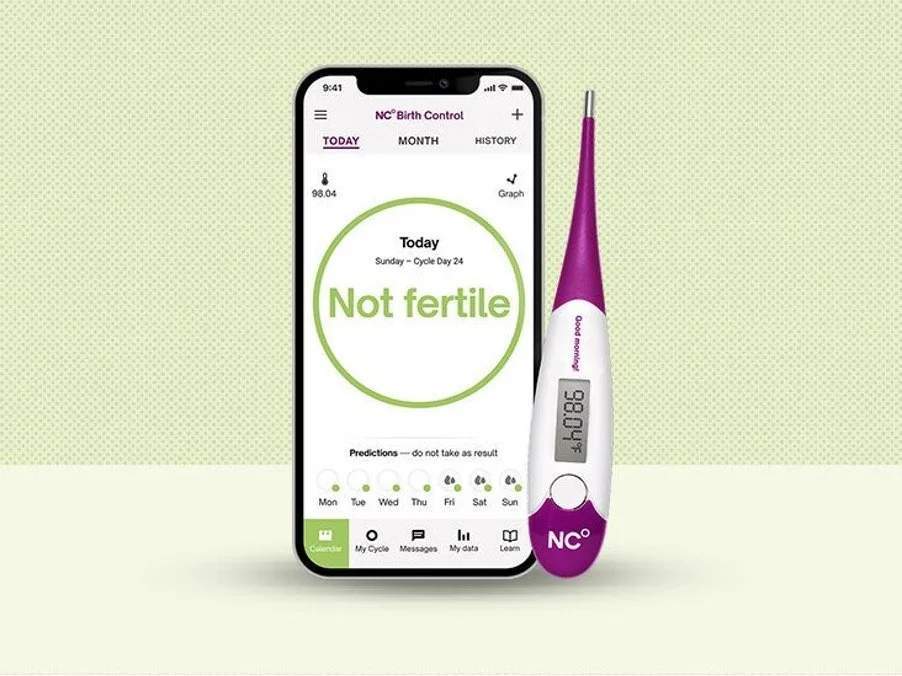
One of the most well-known fertility awareness apps is Natural Cycles, which uses basal body temperature, menstrual cycle data, and a proprietary algorithm to estimate fertile and infertile days. Users record their temperature daily and receive predictions based on accumulated data. It is currently the only fertility app to receive FDA approval and CE certification as a contraceptive, although its early marketing attracted criticism for emphasising perfect-use rather than typical-use effectiveness.
Natural Cycles is only one example, but it represents a broader movement towards digital fertility management.
What does the research say about fertility apps?
The good news is that the research is far from dismissive. Women consistently report valuing fertility awareness apps because they provide:
greater understanding of the menstrual cycle
increased confidence
convenience
reassurance
a sense of control
an alternative to hormonal contraception
easy access to educational information
Studies from Australia, Sweden and the United Kingdom found that many women appreciated having fertility information literally in their pocket. Apps helped them feel more informed and more engaged with their reproductive health.
These are genuine benefits, and I think they're worth celebrating.
Many women have learnt more about their cycles from an app than they ever did through school education or routine healthcare. That alone tells us something important.
But there are important limitations
Alongside these benefits, social scientists have raised thoughtful concerns about how fertility technology may be changing our relationship with our bodies.
Rather than simply supporting fertility awareness, researchers suggest these technologies can reshape it. Instead of asking:
What is my body telling me?
the question slowly becomes:
What is the app telling me?
Researchers describe this shift as creating the "digitised reproductive citizen."
Women are increasingly expected to:
collect daily data
measure themselves accurately
interpret graphs
optimise fertility
monitor every cycle
take responsibility if something goes wrong
The technology promises empowerment. But sometimes empowerment can turn into obligation.
When the algorithm becomes the expert
One of the most interesting findings from the research was how women responded when the app produced unexpected results. Rather than questioning the technology, many questioned themselves.
"Did I take my temperature correctly?"
"Did I wake up too late?"
"Did I move before taking my temperature?"
"Did I drink alcohol last night?"
Temperature-based methods require consistency.
Shift work.
Young children.
Travel.
Interrupted sleep.
Illness.
These very normal parts of life can all affect basal body temperature and the app's predictions.
Instead of recognising these as limitations of the method, many women internalised the responsibility.
The burden quietly shifted back onto them.
The commodification of women's health
Another important issue raised in the literature is commodification. Many fertility apps operate through subscription models. Some encourage additional purchases such as ovulation tests or wearable devices. Others collect extraordinarily personal reproductive data while operating within commercial business models. This isn't necessarily unethical. But it is worth asking:
When did understanding our fertility become something we needed to subscribe to?
Women's reproductive health is becoming increasingly digitised, monetised and data-driven. That deserves thoughtful discussion.
Can technology replace body literacy?
This is where my perspective differs. I don't think technology is the enemy.
I use tech every day. Apps can absolutely support women. But they should remain tools, not teachers. Body literacy means understanding the biological signs your body naturally provides. Technology can reinforce that understanding, not shouldn't replace it.
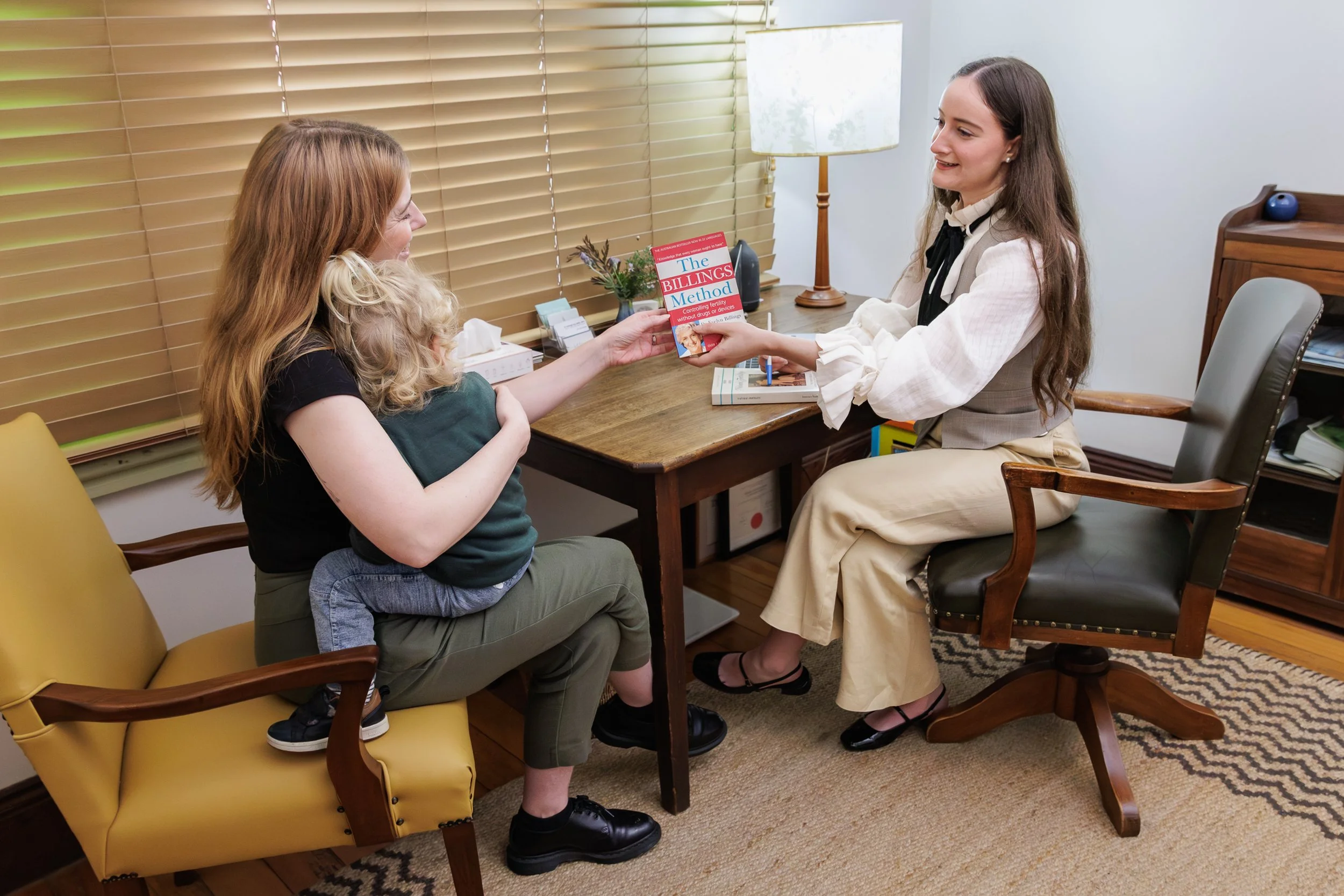
Why I teach the Billings Ovulation Method
The Billings Ovulation Method takes a fundamentally different approach. Rather than asking women to measure fertility through devices or algorithms, it teaches them to recognise one naturally occurring sign that reflects hormonal changes in real time: cervical mucus. That knowledge belongs to the woman.
Not the app.
Not the algorithm.
Not the company.
Not the subscription.
Once learned, it travels with you.
Whether you're:
avoiding pregnancy
trying to conceive
breastfeeding
experiencing irregular cycles
approaching perimenopause
travelling
living without internet
or simply wanting to understand your reproductive health
your body continues communicating.
No batteries.
No Bluetooth.
No wearable.
No annual subscription.
Your fertility isn't stored inside an app. It's expressed through your body every single day.
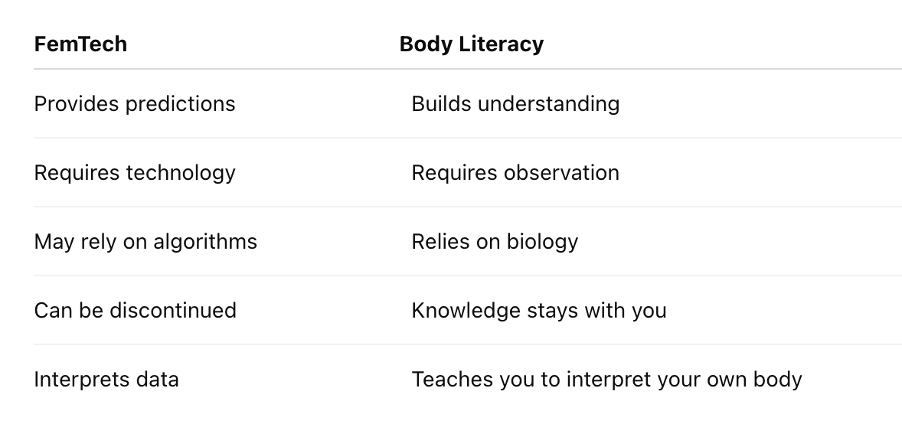
FemTech vs body literacy
This isn't an either-or conversation. Technology can be incredibly valuable. But body literacy offers something technology cannot.
The goal should be to ensure women remain the experts on their own bodies.
My final thoughts
I love that FemTech has sparked conversations about fertility.
I love that more women are becoming curious about their cycles.
I love that women are seeking alternatives to hormonal contraception.
But I also hope we don't lose something deeply valuable in the process.
Our bodies have always communicated with us.
Apps can amplify that knowledge.
They should never replace it.
For me, the most empowering form of fertility awareness is one that builds confidence in your own observations, not dependence on an algorithm. Because your body doesn't need Wi-Fi to communicate. It simply needs someone who knows how to listen.
Frequently asked questions
Are fertility tracking apps accurate?
Some fertility apps have evidence supporting their use, particularly when used exactly as instructed. However, accuracy depends on consistent use, individual circumstances, and the method the app relies on. Typical-use effectiveness is generally lower than perfect-use effectiveness.
Is the Billings Ovulation Method the same as using an app?
No. The Billings Ovulation Method is a fertility awareness method that teaches women to recognise and interpret naturally occurring cervical mucus patterns. While an app can be used to record observations, the method itself does not depend on technology or algorithms.
Can I use both Billings and a fertility app?
Yes. Many women choose to use an app as a recording tool while relying on their understanding of the Billings Method to interpret their fertility. The key difference is that the app supports, not replaces, body literacy.
Learn more
If you'd like to understand your cycle beyond an app, the Billings Ovulation Method offers a practical, evidence-based way to develop lifelong body literacy. Whether you're hoping to conceive, avoid pregnancy naturally, or simply better understand your reproductive health, learning to recognise your body's own signs is a skill you carry with you for life.